7 Best CoinTracker Alternatives for DeFi & Multi-Chain in 2026

Updated in March 2026 - Revised for current IRS guidance and multi-chain DeFi activity.
Key takeaways
Blockstats is the best CoinTracker alternative for a crypto tax calculator in 2026
CoinTracker is suitable for basic portfolios but struggles with advanced DeFi and multi-chain activity.
Blockstats stands out for traders who need high-accuracy, multi-chain, DeFi-first tax reporting.
Looking for a CoinTracker alternative that actually works for DeFi and multi-chain wallets?
Many users find that CoinTracker struggles with trading activities such as LP tokens, bridging, and complex transactions, leading to inaccurate tax reports. For that reason, many traders are searching for alternatives to CoinTracker.
We tested 7 leading crypto tax tools using real-world transactions, including Coinbase, Uniswap LP tokens, cross-chain bridges, NFT trades, and staking rewards across Ethereum, Arbitrum, and Solana. Each platform was evaluated on portfolios ranging from 500 to 25,000 transactions to measure accuracy, automation, and manual effort required.
Read next: How to calculate crypto taxes in the USA
7 Best CoinTracker alternatives in 2026
These 7 CoinTracker competitors are based on features, DeFi support, multi-chain accuracy, pricing, and IRS tax reporting compliance in 2026.
|
Software |
DeFi & Multi-Chain Support |
Pricing |
Free Plan |
Portfolio Tracker |
IRS Tax Reports |
Best For |
|
Blockstats |
Advanced (DeFi, bridges, LPs, multi-chain) |
$69-$169/year |
✅ |
✅ |
8949, Schedule D |
Traders, DeFi users, high-volume traders |
|
CoinLedger |
Moderate |
$49-$199/year |
✅ |
✅ |
8949, Schedule D |
Simple portfolios |
|
Koinly |
Moderate |
$49-$199/year |
✅ |
✅ |
8949, Schedule D |
Budget-focused users |
|
Bitcoin.Tax |
Limited |
$54.95-$99.95/year |
✅ |
❌ |
8949 |
Very small portfolios |
|
TokenTax |
Advanced (paid tiers) |
$49 - $3,499/year |
❌ |
❌ |
8949, Schedule D |
White-glove tax service |
|
Awaken Tax |
Strong DeFi focus |
$99-$199/year |
✅ |
✅ |
8949, Schedule D |
Active DeFi traders |
|
ZenLedger |
Moderate–Strong |
$49-$399/year |
✅ |
❌ |
8949, Schedule D |
CPAs & audits |
What is CoinTracker?
CoinTracker is a crypto portfolio tracker and tax reporting platform founded in 2017. The software connects to exchanges and wallets to track holdings, calculate gains and losses, and generate tax reports. While it's one of the most recognized names in crypto tax software, it has limitations with DeFi protocols and premium pricing for high-volume traders.
Why you need a CoinTracker alternative in 2026
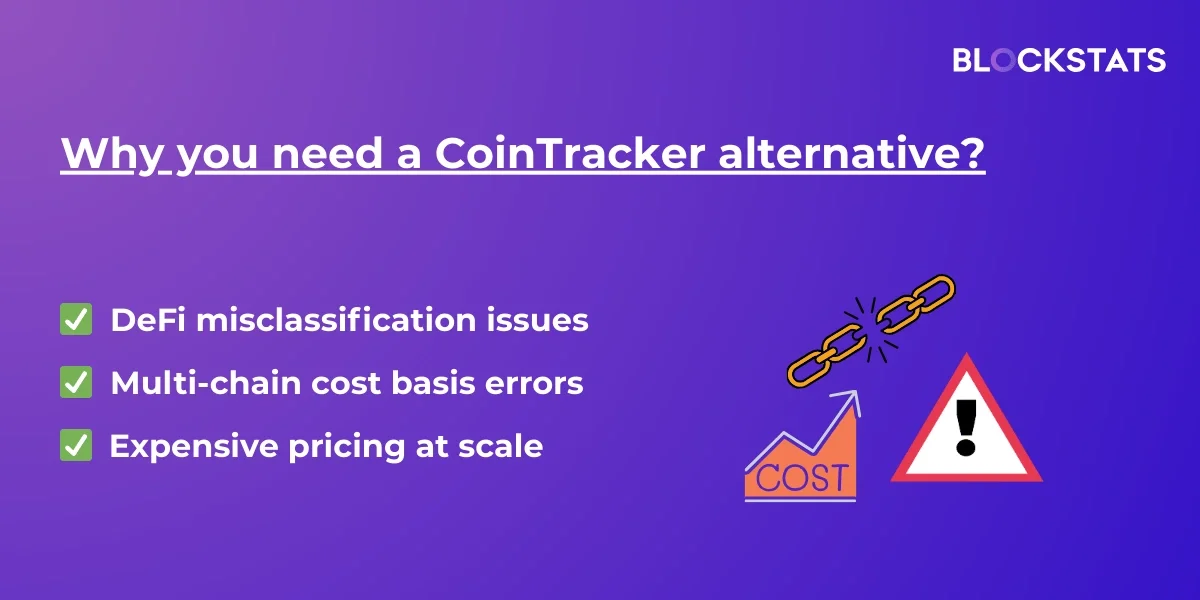
Crypto activity has evolved faster than most tax tools. DeFi introduces complex transaction types, liquidity pool deposits, reward harvesting, bridging assets across chains, and wrapped token conversions. These are often misclassified by basic software, which is a common issue in most crypto tax software that fails at DeFi. Multi-chain wallets further complicate cost-basis tracking, especially when assets move between networks. Even the platform's pricing also scales steeply, reaching $1,999/year for portfolios with high transaction counts.
For US investors, these inaccuracies matter. Incorrect classifications can lead to mismatched totals on IRS Form 8949, incorrect capital gains on Schedule D, and discrepancies with exchange-issued 1099-DA forms. That’s why many users now look beyond CoinTracker to DeFi-first alternatives.
1. Blockstats (Best Overall for DeFi & Multi-Chain Accuracy)
Blockstats is an AI-powered crypto tax software and portfolio tracker built specifically for modern traders dealing with DeFi, NFTs, and multi-chain portfolios. Unlike traditional trackers, it emphasizes transaction-level accuracy, ensuring complex activity is classified correctly before tax forms are generated.
Pros
-
Advance DeFi support handles Uniswap LP tokens, bridge transactions, wrapped token conversions, and complex protocol interactions without misclassification
-
AI-powered tax optimization identifies missed tax loss harvesting opportunities that reduce tax liability
-
Built by crypto traders and tax professionals, ensuring solutions for actual trading challenges
-
Supports FIFO, LIFO, and HIFO cost-basis methods
-
Generates IRS-ready Form 8949 and Schedule D within minutes
Cons
-
Blockstats does not accept cryptocurrencies like Bitcoin and Ethereum as payment.
-
Best value unlocked at paid tiers
Why is Blockstats the best CoinTracker alternative?
Blockstats stands out as the best crypto tax software because it actually works with complex transactions instead of forcing manual corrections. The platform's AI automates data entry and it actively finds tax savings through loss harvesting and deduction identification.
For taxpayers, this means accurate Form 8949 and Schedule D generation with TurboTax compatibility, all while tracking portfolio performance in real-time. The $119/year Pro plan offers exceptional value for active traders managing up to 2.500 transactions annually. This becomes especially important for portfolios with hundreds or thousands of transactions where manual corrections are not scalable.
If you're comparing tools directly, you can also review a detailed breakdown of CoinTracker vs Blockstats to understand differences in accuracy, pricing, and DeFi support.
2. CoinLedger
CoinLedger is a user-friendly crypto tax platform trusted by investors worldwide. The software focuses on simplicity and ease of use, making it accessible for crypto newcomers and casual traders.
CoinLedger offers integrations with hundreds of exchanges and provides optional professional tax services for those who prefer hands-off reporting. You can also compare CoinLedger vs Blockstats to evaluate differences in ease of use and DeFi capabilities.
Pros
-
Easy-to-use interface with quick onboarding
-
Free portfolio tracking and imports
-
Generates IRS-compliant tax reports
-
Good customer support availability
Cons
-
Limited DeFi functionality struggles with LP rewards, yield farming, and complex protocol interactions
-
Manual adjustments are often required for multi-chain activity
-
Basic cost basis tracking doesn't match the minute-level precision needed for high-frequency DeFi trading
3. Koinly
Koinly is a globally popular crypto tax platform known for its exchange and blockchain coverage. It allows users to import wallets via APIs or CSV files and provides capital gains calculations aligned with tax requirements.
However, users frequently report issues with transaction labeling, especially for liquidity pool interactions, token migrations, and cross-chain transfers. These inaccuracies don’t invalidate the reports but often require manual fixes to ensure cost basis, and gains are calculated correctly. While Koinly offers broad integrations, users often prefer Blockstats for automated DeFi accuracy.
Pros
-
Broad exchange and blockchain integrations
-
Different pricing tiers
-
Supports NFTs, staking, and margin trading
-
Free plan for portfolio tracking
Cons
-
Frequent transaction mislabeling, especially with DeFi protocols and cross-chain activity
-
Historical pricing gaps for less common tokens lead to inaccurate valuations
-
Manual reconciliation is required for accuracy
Check out: Free crypto tax calculator →
4. Bitcoin.Tax
Bitcoin.Tax is one of the oldest crypto tax platforms, originally founded in 2013. The software focuses on straightforward tax reporting for traditional cryptocurrency transactions across major exchanges.
While it's been in the market longer than most competitors, its limited blockchain support and lack of advanced DeFi features make it less suitable for modern multi-chain portfolios.
Pros
-
Simple setup for minimal transactions
-
Free plan for small portfolios covering users with fewer than 20 transactions per year
-
Established platform with over a decade of crypto tax reporting experience
Cons
-
Limited blockchain support with no clear documentation of supported chains beyond Ethereum
-
No DeFi or NFT functionality, making it unsuitable for yield farming, LP tokens, or protocol interactions
-
No tax-loss harvesting features are missing opportunities to optimize tax liability
5. TokenTax
TokenTax is both crypto tax software and a full-service accounting firm offering premium services for complex portfolios. The platform caters to high-net-worth individuals, crypto businesses, and those who prefer professional accountants handling their taxes. TokenTax provides enterprise plans and dedicated tax preparation services.
Pros
-
Handles complex portfolios and large transaction volumes
-
Customer support at every tier, including basic plans
-
Strong audit and compliance support in premium plans
Cons
-
Expensive pricing starting at $65 for 100+ transactions
-
No free version, unlike most competitors
-
Overkill for simple portfolios with pricing targeting professional-level needs
6. Awaken
Awaken is a crypto tax platform focused on DeFi and multi-chain. The software handles transactions including yield farming, NFT trades, and cross-chain activity. Awaken positions itself as a solution for traders frustrated by traditional tax software's DeFi limitations.
The ecosystem is smaller than more established platforms. While it performs well for supported chains, users with diverse wallets or less common blockchains may encounter integration gaps.
Pros
-
DeFi protocol supports handling complex yield farming and liquidity pool transactions
-
Multi-chain tracking across Solana, Ethereum, and other major blockchains
-
Free trial available to test DeFi tracking before purchasing
Cons
-
Limited niche protocol coverage for extremely new or obscure DeFi platforms
-
Advanced reporting features are still being refined for extremely high-volume portfolios
7. ZenLedger
ZenLedger is a crypto tax solution commonly used by CPAs and users preparing for audits. The software emphasizes audit support and integration with tax professionals, making it popular among users concerned about IRS scrutiny.
ZenLedger offers TurboTax compatibility and provides audit defense features. The platform's most advanced features are reserved for higher pricing tiers.
Pros
-
Audit support features, including documentation and professional assistance
-
DeFi, staking, and NFT support in higher-tier plans
-
Its dashboard interface is relatively user-friendly
-
Tax-loss harvesting reports identifying offset opportunities
Cons
-
Paid support requirement costing extra $600 for live assistance in the Unlimited Plan
-
Less suitable for active DeFi traders
-
A complicated user experience with a steep learning curve is reported by users
Checkout: free crypto profit calculator →
What features should crypto tax software have?
Here are the key features you should look for when picking crypto tax software for DeFi and multi-chain.
- Ease of use: A clear dashboard, intuitive transaction review, and simple error resolution reduce the time needed to prepare tax reports, especially for users managing multiple wallets and exchanges.
- Automatic import: Look for API-based imports for exchanges and wallet address syncing for blockchains. Reliable auto-import reduces manual CSV uploads and minimizes missing or duplicated transactions.
- DeFi and NFT support: The software should correctly classify trading, liquidity pools, yield farming rewards, bridging, and NFT trades. Many tools mislabel these transactions, which leads to incorrect tax reports. This is a known limitation in CoinTracker, while platforms like Blockstats are designed to handle these accurately.
- Pricing: Pricing should scale reasonably with transaction volume and portfolio complexity. Free plans are useful for testing accuracy, while paid tiers should justify advanced features. Blockstats paid plans start at $69/year for 1,000 transactions and scale to $169/year for 30,000 transactions.
- Trades supported: The platform should support spot trades, staking rewards, margin trading, derivatives, NFTs, and DeFi protocol interactions across multiple chains.
- Customer support: Responsive support is critical during tax season, particularly when resolving misclassified transactions or reconciling large portfolios.
- IRS Form generation: Compliant tax software must generate Form 8949, Schedule D, and integrate with TurboTax, CPA workflows, or other filing platforms. Review the IRS crypto tax forms requirements to ensure your software produces proper documentation.
Pro tip: If you trade across multiple chains or use DeFi protocols, prioritizing accuracy and automation over pricing is critical, this is where most basic tools fall short.
Which CoinTracker alternative is best for US Investors?
For US investors, Blockstats is the best CoinTracker alternative crypto tax software for accuracy while staying compliant with IRS rules.
-
High-volume or DeFi traders benefit most from Blockstats.
-
Casual holders prefer CoinLedger, Blockstats, or Bitcoin.Tax for simplicity.
-
Budget-focused users can choose Blockstats or Koinly for broad coverage at a lower price.
-
CPAs and audit-focused users typically lean toward ZenLedger or TokenTax.
Pro tip: If you're specifically looking for a CoinTracker free alternative, several tools in this list offer free plans for portfolio tracking. However, most free tiers have limitations, and accurate tax reporting for DeFi activity usually requires a paid plan. If you still want to explore a free alternative, try out Blockstats free version.
When should you switch from CoinTracker?
You should consider switching from CoinTracker if:
-
You use DeFi protocols like Uniswap, staking, or yield farming
-
You frequently bridge assets across multiple blockchains
-
Your transactions are being misclassified or require manual fixes
-
You’ve outgrown the limitations of the CoinTracker pricing free tier
For these use cases, switching to a more advanced alternative like Blockstats will improve tax accuracy and reduce manual work.
Conclusion
CoinTracker remains useful for basic crypto portfolios, but it lacks the complexity. Blockstats is the overall best alternative to CoinTracker in 2026, especially for DeFi and NFTs. The tax software offers a practical balance between automation, transparency, and affordability, making it a strong option for CoinTracker alternatives.

Get started with crypto tax software
If you’re ready to simplify crypto taxes without sacrificing accuracy, Blockstats offers a free plan to get started. Connect your wallets and exchanges, track your portfolio, and generate IRS-ready reports.
Join 2,000+ traders who switched to Blockstats for accurate DeFi tracking and real tax savings.
Frequently asked questions
What is the best crypto tax software for DeFi?
Among major CoinTracker competitors, Blockstats stands for DeFi with AI-powered optimization, cost basis tracking across 15,000+ tokens, and protocol support for LP tokens, bridges, and complex transactions that other platforms misclassify.
What is the best way to file crypto tax in the US?
The best way to file crypto taxes is using automated software like Blockstats that connects to your exchanges and wallets. Then calculates cost basis with FIFO/LIFO/HIFO methods, and generates your tax reports, eliminating manual spreadsheet errors.
What are the best CoinTracker competitors in 2026?
The top CoinTracker competitors include Blockstats, CoinLedger, Koinly, TokenTax, and ZenLedger. The best choice depends on whether you prioritize DeFi support, pricing, or audit features, where Blockstats is solid, or if you want basic tracking like TokenTax and CoinLedger.
Can I automate portfolio tracking and tax reporting?
Yes. Most modern tools automatically sync wallets and exchanges, calculate gains and losses, and generate tax reports with minimal manual input.
What is a cheaper alternative to CoinTracker?
Blockstats' cheapest plan starts at $69/ for 1000 transactions. It offers better value at $119/year (2,500 tx) vs CoinTracker's $1,999/year (1,000 tx). Koinly and CoinLedger offer $49 options to get started, but their $49 plans include only 100 transactions, which is suitable for basic portfolios. So you have to upgrade anyway, which costs much more than Blockstats' pricing.
Which CoinTracker alternative is best for different trading styles?
Blockstats is a strong CoinTracker alternative for various trading and investing styles in the US and globally.