Best Crypto Tax Software for High-Volume and Multi-Exchange Traders…
Last updated: March 2026 / Reviewed against current IRS guidance, 1099-DA readiness, and real-world multi-exchange trading activity.
Key takeaways
High-volume traders need more than basic tax reporting. Speed, cost-basis accuracy, and DeFi support matter more than brand recognition.
Not all “unlimited transactions” claims hold up in practice. Many tools slow down or require expensive upgrades at scale.
Blockstats is the best crypto tax software for high-volume traders in 2026, especially for multi-exchange, DeFi, and automated strategies.
High-volume crypto trading has changed dramatically. In 2026, traders are no longer placing spot trades on a single crypto exchange. They’re running arbitrage bots, grid strategies, futures, DeFi swaps, staking, LP positions, and cross-chain transfers, often across five, ten, or even twenty platforms. That complexity creates one unavoidable problem: tax reporting breaks at scale. This guide breaks down the best crypto tax software for high-volume traders trading on multiple exchanges.
Best crypto tax software for high-volume traders (2026)
Below is a high-level comparison of the top crypto tax tools for high-volume, multi-exchange traders, evaluated specifically for active US traders dealing with thousands, or tens of thousands, of transactions per year.
|
Tool |
Transaction Capacity |
Multi-Exchange Support |
DeFi & NFTs |
Cost Basis Accuracy |
IRS Forms |
Best For |
|
Blockstats |
Up to 100,000+ |
500+ integrations |
Full DeFi, LPs, NFTs |
Minute-level, cross-wallet |
8949, Schedule D, TurboTax |
High-volume & pro traders |
|
TokenTax |
High (custom tiers) |
Strong |
Limited automation |
Good |
IRS-ready |
White-glove users |
|
CoinTracker |
Moderate |
Strong CEX focus |
Limited DeFi |
Fair |
IRS-ready |
Casual → semi-active |
|
Koinly |
High (paid tiers) |
Broad |
Partial DeFi |
Inconsistent at scale |
IRS-ready |
International users |
|
ZenLedger |
High (expensive tiers) |
Good |
Limited DeFi |
Fair |
IRS-ready |
CPA-assisted filers |
#1 Blockstats
Blockstats is built specifically for traders who have outgrown other crypto tax tools. Unlike platforms that started as portfolio trackers and bolted on tax features, Blockstats was designed from day one to handle scale, speed, and complexity.
Key features
Blockstats connects to 500+ exchanges, wallets, and blockchains, syncing transactions automatically without CSV uploads. Its historical price engine tracks 15,000+ tokens with accuracy, which is critical for traders executing high-frequency strategies or cross-exchange arbitrage.
What separates Blockstats is cost basis continuity. Assets moved between wallets, chains, or exchanges retain their original cost basis, one of the most common failure points in crypto tax reporting. If needed, 1:1 with a dedicated specialist to help manage taxes from multiple exchanges and high volumne transaction, Blockstats full service offers certified tax professionals with deep expertise in cryptocurrency taxation and blockchain technology.
Blockstats pricing and transaction review
Blockstats pricing is transparent and trader-friendly:
|
Plan |
Price |
Transactions |
|
Free |
$0 |
250 |
|
Basic |
$99/yr |
1,000 |
|
Plus |
$149/yr |
2,500 |
|
Pro |
$199/yr |
30,000 |
-
For active traders, the Plus plan at $99/year covers up to 2,500 transactions with full AI search and cost-basis switching.
-
High-volume traders should consider the Pro plan at 199/year, which supports up to 30,000 transactions with real-time staking sync and a dedicated account manager. The Elite plan offers one of the best price-to-scale ratios in the market.
Pros and cons for traders
Pros
-
Highest transaction ceiling at its price point
-
Handles very high transaction volume without slowing down
-
Excellent DeFi, LP, and cross-chain support
-
Accurate, defensible cost basis for IRS audits
Cons
-
Advanced features may feel overpowered for buy-and-hold users
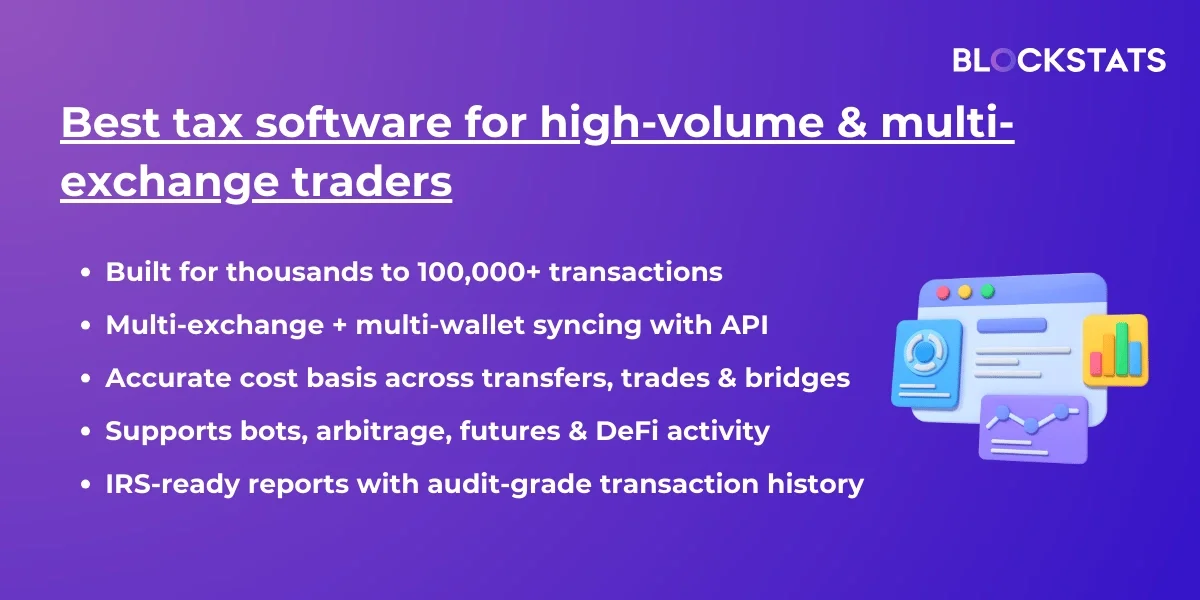
Blockstats is the best crypto tax software for traders using multiple exchanges, especially those trading actively across CEXs and DeFi.
#2 TokenTax
TokenTax operates as both software and a CPA firm. It appeals primarily to traders who want hands-on assistance rather than full self-service automation.
TokenTax supports major exchanges and wallets, offers IRS-ready reporting, and provides optional CPA review services. It’s capable of handling high transaction volumes, but much of the heavy lifting still relies on manual review.
TokenTax pricing and transaction review
-
Pricing runs from $49/year for 100 transactions to $3,499/year for 30,000 transactions.
-
DeFi and NFT support requires a Premium plan of $199/year or above.
Pros and cons for traders
Pros
-
White-glove support for investors
-
CPA-friendly workflows
-
Different pricing plans to choose from
Cons
-
Expensive at scale
-
Limited automation for complex DeFi
TokenTax works best for traders who require human oversight over automation, but it’s not the most efficient tool for daily high-frequency activity.
#3 CoinTracker
CoinTracker is one of the most recognizable crypto tax tools, largely due to early exchange partnerships. However, its strengths lean toward simplicity, not scale.
CoinTracker integrates well with major US exchanges and offers clean tax reports. For traders with a few thousand transactions, it performs adequately.
CoinTracker pricing and transaction review
-
The price jumps from $199/year for 1,000 transactions to $599/year for 10,000 transactions is steep.
-
The Ultra+ at $1,999/year is expensive compared to Blockstats Pro at $199/year for 30,000 transactions.
-
Costs rise quickly as transaction counts increase, and advanced DeFi activity often requires manual intervention.
Pros and cons for traders
Pros
-
Easy setup for casual investors
-
High ceiling on Ultra+
-
Strong crypto exchange integrations
Cons
-
Struggles with complex DeFi
-
Performance issues at higher volumes
CoinTracker is better suited for casual to moderately active traders, not professionals running multi-exchange strategies.
#4 Koinly
Koinly has broad international support and a large integration library, making it popular outside the US. However, high-volume US traders often encounter friction.
Koinly supports many blockchains and wallets, but DeFi handling is inconsistent, especially for LP tokens and advanced smart-contract interactions.
Koinly pricing and transaction review
-
The Hodler costs $99/yr, and the Trader costs $179/yr plans cap at 1,000 and 3,000 transactions, respectively.
-
The Pro plan is $279/yr for handles 10,000, then charges an additional cost for more transactions, which compounds fast for bot traders.
-
High-volume plans can become expensive, and transaction re-processing at scale can be slow.
Pros and cons for traders
Pros
-
Better international coverage
-
Wide chain coverage
-
Support different trading and investing styles
Cons
-
Cost basis errors at scale
-
DeFi often requires manual fixes
-
High-volume costs escalate with add-ons
Koinly works well for international portfolios, but US high-frequency traders usually need more affordable and US-focused crypto tax software like Blockstats.
#5 ZenLedger
ZenLedger focuses on compliance and CPA workflows, rather than speed or advanced automation. The trade-off is that ZenLedger was built for compliance, not trading intelligence. Portfolio analytics are minimal, and some DeFi categorization still requires manual review.
If you want to file cleanly and hand off the work, it delivers. If you want your tax data to sharpen your trading decisions, you'll need a separate tool.
ZenLedger pricing and transaction review
High-volume plans are among the most expensive in this list.
Pros and cons for traders
Pros
-
CPA filing add-on
-
Strong audit documentation
Cons
-
Not optimized for DeFi or HFT
-
High cost for large transaction volumes
ZenLedger is best for traders who rely heavily on accountants, not those seeking automation.
What makes crypto tax software high-volume ready in 2026?
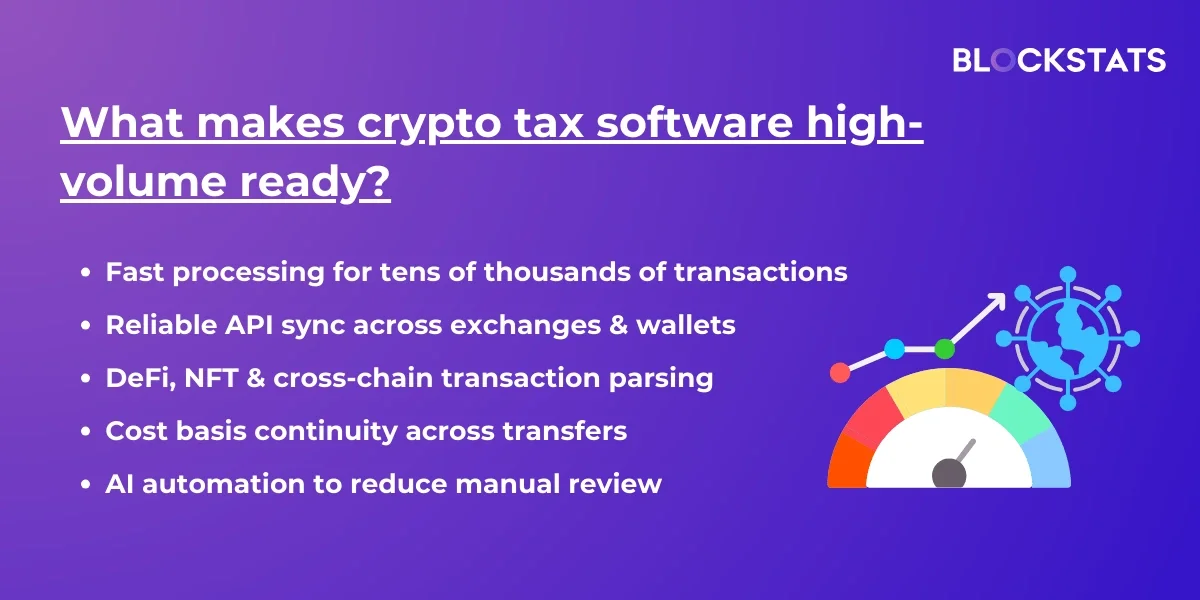
Not every platform that calls itself a crypto tax tool is built for traders moving thousands of transactions per month. Here's what actually separates capable platforms from ones that leave you reconciling manually at 2 a.m. in April.
Transaction capacity and speed
High-volume crypto tax software must process tens of thousands of transactions without lag. Slow recalculations and timeouts are a red flag.
Multi-exchange and multi-wallet Sync
US traders often move assets across exchanges for liquidity, arbitrage, or custody reasons. The tax software should have tested integration of popular exchanges, wallets, and blockchains, not 1000+ random, untested integration counts. Pick native API integrations over manual CSV import.
DeFi, NFT, and cross-chain support
In 2026, DeFi isn’t optional. Software must understand swaps, LP tokens, staking rewards, bridges, and NFT activity. Blockstats covers DeFi tax reporting and NFT cost basis natively. If a platform charges extra for Solana or Polygon support, it wasn't built for how traders actually operate in 2026.
Cost basis accuracy across accounts
When you move ETH from Coinbase to MetaMask, that acquisition cost has to travel with it. Many platforms lose cost basis continuity on cross-wallet transfers, which inflates your taxable gains. Blockstats tracks cost basis across every account in real time.
AI-powered transaction categorization
In a portfolio with 50,000 transactions, manually reviewing flagged items is impractical. Blockstats AI categorization, which identifies transfer types, spots duplicates, and surfaces recoverable losses, is essential.
How to choose crypto tax tools for multi-exchange users in 2026
Transaction volume handling
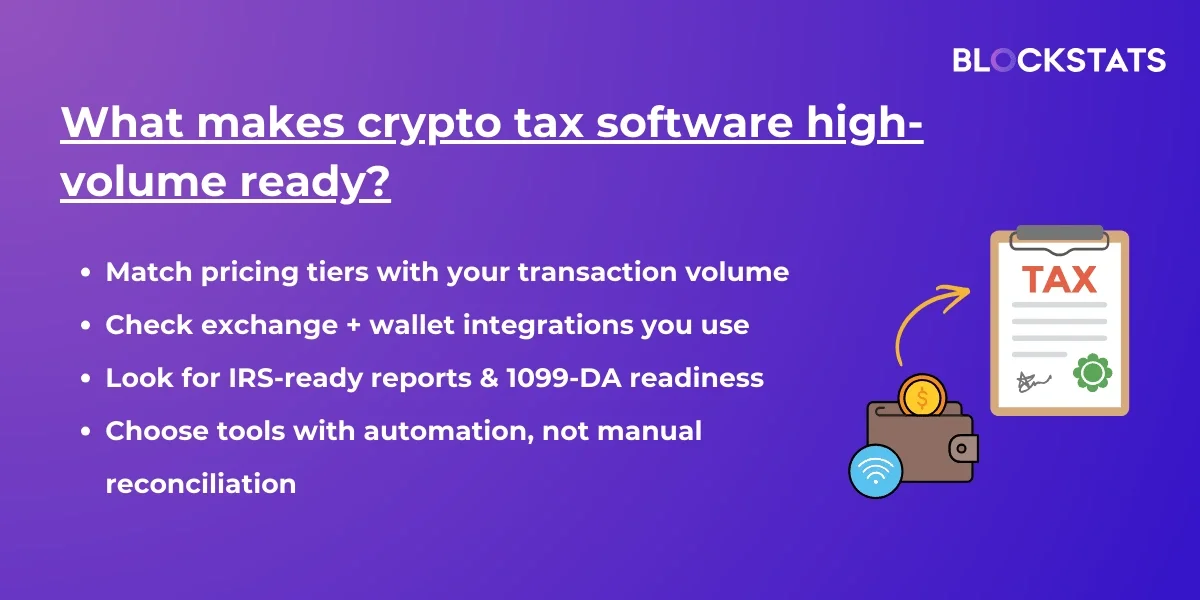
Map out your approximate transaction count for the past year, trades, transfers, staking rewards, and DeFi interactions included. Then look at per-tier price jumps across platforms.
Pricing plans
A $49/year plan capped at 100 transactions is misleading marketing. Look for predictable scaling. Moving from 10,000 to 100,000 transactions costs $1,700 more on CoinTracker (Ultra to Ultra+), versus $150 more on Blockstats (Pro to Elite at $299/year).
Exchange and wallet coverage
Coverage should include both major US exchanges and DeFi wallets like Coinbase, Binance US, Kraken, MetaMask, or Solana wallets. Don't rely on headline integration counts. Check your specific platforms against the native API list.
CPA and audit needs
Blockstats produces detailed audit-ready reports and crypto tax audit preparation documentation suitable for professional review. You can download and share Blockstats tax reports with your CPA and accounting firms.
Your jurisdiction
US traders need IRS-first reporting, with awareness of 1099-DA and evolving guidance. Both Blockstats and Koinly operate in all major countries, such as the US, UK, and India. For traders filing in multiple jurisdictions simultaneously
Performance, automation, and scalability
Bot traders, running grid, DCA, or arbitrage strategies, need platforms that handle volume spikes without sync errors or duplicate transactions. Manual categorization doesn’t scale. Automation does.
Tax reporting accuracy and compliance
The IRS is expanding crypto oversight, including incoming 1099-DA reporting requirements. A platform built to support 1099-DA readiness and one that correctly distinguishes taxable vs. non-taxable crypto transactions is audit protection.
How to get started with the DeFi tax calculator in 2026
Getting your full crypto tax picture set up on Blockstats takes under 5 minutes. No spreadsheets, no CSV juggling.
-
Sign up for a free Blockstats account
-
Connect exchanges and wallets
-
Review auto-categorized transactions
-
Generate IRS-ready tax reports
Verdict: Best crypto tax software for High-Volume and Multi-Exchange Traders
If you’re running thousands of trades across exchanges, Blockstats is the best crypto tax software for high-volume traders in 2026.
Most crypto tax tools work, until they don’t. Scale exposes weaknesses fast. Blockstats combines speed, accuracy, automation, and price transparency better than any competitor. It’s built for real traders.
FAQs – Crypto tax software for active traders
What is the best crypto tax software for high-volume traders?
Blockstats is the best option for handling high transaction volumes, multi-exchange trading, and DeFi activity with accurate IRS reporting. It handles up to 100,000 transactions on the Elite plan at $299/year with AI-powered optimization, real-time cost basis tracking, and full DeFi support across popular integrations.
Can crypto tax software handle thousands of trades across exchanges?
Yes. Platforms like Blockstats, CoinTracker Ultra+, and ZenLedger Platinum support high transaction volumes. Blockstats handles up to 100,000 transactions with automated cross-wallet cost basis tracking and real-time sync across all major CEXs and DeFi wallets.
Do I need a CPA if I use crypto tax software?
Not always. Advanced software can replace manual CPA work, though complex cases may still benefit from review.
Which cost basis method should high-volume traders use?
FIFO is common in the US, but advanced traders may benefit from switching methods where allowed. See how FIFO and LIFO affect your crypto tax liability before deciding.
Is Blockstats compliant with IRS rules in 2026?
Blockstats generates Form 8949 and Schedule D in line with current IRS guidance and is built to support 1099-DA requirements. It also correctly handles wallet-by-wallet cost basis tracking per the IRS's latest guidance on crypto reporting.